
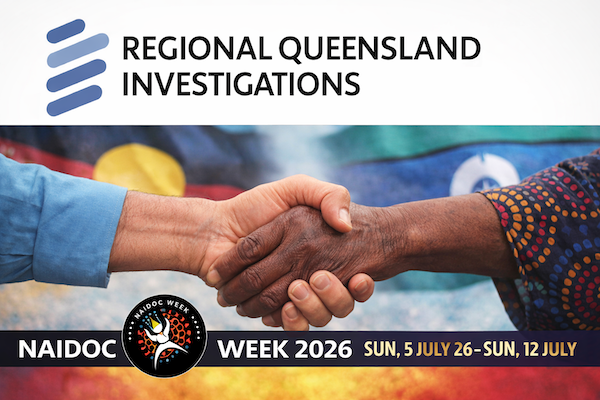
NAIDOC Week – Accountability, Cultural Safety and Investigations in Queensland
NAIDOC Week: Sunday 5 July – Sunday 12 July 2026
NAIDOC Week is a time to recognise and respect the history, culture, and contributions of Aboriginal and Torres Strait Islander peoples.
For those working in investigations, NAIDOC Week is also an opportunity to reflect on how systems of authority interact with First Nations people, particularly in regional and remote Queensland — and where those systems sometimes fail.
Why NAIDOC Week Matters in Investigative Work
Investigations do not occur in a vacuum. They occur within communities, histories, and power structures.
In Queensland, Aboriginal and Torres Strait Islander people are disproportionately represented in:
Police interactions
Child protection systems
Guardianship and substitute decision-making arrangements
Custodial settings
NAIDOC Week provides a framework for recognising that cultural context, lived experience, and historical disadvantage matter when allegations are assessed and decisions are made.
Accountability and Cultural Safety Are Not Opposites
Cultural safety does not mean lower standards.
It means fair, lawful, and informed processes.
In investigations involving First Nations individuals or families, this includes:
Ensuring allegations are properly investigated, not dismissed or assumed
Avoiding stereotyping or preconceived narratives
Recognising how trauma and distrust of institutions can affect disclosure
Applying the law consistently, regardless of background or location
True accountability strengthens trust — it does not undermine it.
Common Issues We See in Regional Queensland
1. Disproportionate Scrutiny and Assumptions
In some cases, Aboriginal and Torres Strait Islander people experience:
Heightened scrutiny
Faster escalation to enforcement actions
Reduced benefit of the doubt
This can lead to investigations that focus on control rather than fact-finding.
2. Barriers to Being Heard
We regularly encounter situations where:
Concerns raised by First Nations families are not taken seriously
Complaints are lost between agencies
Cultural or communication differences are misinterpreted as non-compliance
When people disengage, it is often labelled as indifference — rather than recognised as a response to repeated institutional failure.
3. Over-Representation in Protective and Coercive Systems
Guardianship, child protection, and justice systems are intended to protect — but without proper oversight, they can cause harm.
Independent investigations are often the only mechanism capable of:
Reviewing whether powers were used lawfully
Assessing whether less restrictive options were considered
Identifying systemic patterns rather than isolated incidents
The Role of Independent Investigations
Independent investigations provide:
External scrutiny free from internal bias
Evidence-based findings suitable for regulators, courts, and oversight bodies
Clear documentation of decision-making and process
Accountability pathways when systems fail or stall
This is particularly important in regional Queensland, where:
Resources are stretched
Relationships overlap
Escalation options may feel inaccessible
NAIDOC Week and the Principle of Fair Process
NAIDOC Week reminds us that justice is not simply about outcomes — it is about process.
Fair process means:
Listening properly
Investigating thoroughly
Applying the law consistently
Respecting dignity and cultural context
Being accountable when mistakes are made
These principles benefit everyone.
Our Position
At Regional Queensland Investigations, we approach all matters — including those involving Aboriginal and Torres Strait Islander people — with a commitment to:
Independence
Evidence-based inquiry
Cultural respect
Lawful and proportionate use of authority
NAIDOC Week is an important reminder that trust in systems is earned through transparency, fairness, and accountability, not assumption or convenience.

Jason King is the Director of Regional Queensland Investigations Pty Ltd. He has a background in law enforcement, compliance, workplace investigations and corporate investigations, assisting businesses and organisations across regional Queensland and the Northern Territory.