
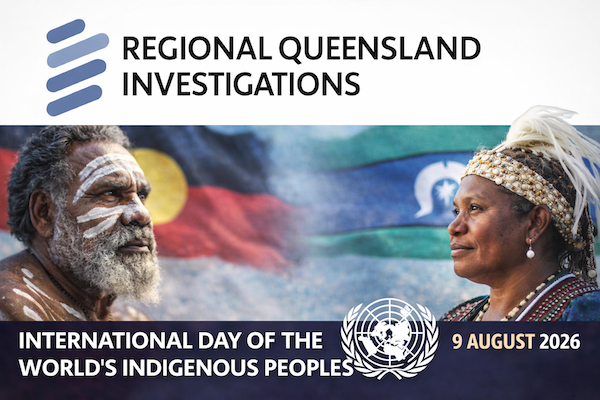
International Day of the World’s Indigenous Peoples – Accountability and Fair Process in Investigations
The International Day of the World’s Indigenous Peoples is recognised globally as a time to reflect on the rights, dignity, and lived experiences of Indigenous peoples, and on how systems of authority interact with them.
For those working in investigations in Queensland, this day is particularly relevant. It highlights the importance of fair process, lawful use of power, and accountability, especially where investigations involve Aboriginal and Torres Strait Islander people in regional and remote communities.
Why This Day Matters in Investigative Work
Investigations often sit at the intersection of law, authority, and vulnerability. Where Indigenous peoples are involved, historical disadvantage, cultural context, and institutional mistrust must be understood — not as excuses, but as factors that shape how systems operate and how people engage with them.
Across Queensland, Aboriginal and Torres Strait Islander people remain disproportionately affected by:
Policing and enforcement actions
Child protection and guardianship systems
Custodial and protective interventions
Regulatory decisions made with limited local context
This reality makes accountability and independent oversight essential, not optional.
Fair Process Is Central to Justice
Justice is not defined solely by outcomes. It is defined by how decisions are reached.
In investigations involving Indigenous peoples, fair process includes:
Properly assessing allegations without assumption or bias
Ensuring decisions are evidence-based, not influenced by stereotypes
Recognising cultural, communication, and historical factors that may affect disclosure
Applying the law consistently, regardless of background or location
When fair process breaks down, trust erodes — and harm often follows.
Challenges Seen in Regional and Remote Queensland
1. Over-Representation Without Oversight
Protective and coercive systems are intended to safeguard individuals and communities. However, without strong oversight, these systems can cause harm.
We regularly see matters where:
Powers are exercised with limited external review
Decisions escalate quickly without proportional assessment
Less restrictive alternatives are not properly considered
Independent investigation is often the only way these issues are identified.
2. Barriers to Raising Concerns
Indigenous individuals and families may face significant barriers when raising concerns, including:
Fear of retaliation or further intervention
Lack of confidence in complaint pathways
Previous negative experiences with authorities
When concerns are not properly heard or investigated, silence is often mistaken for consent.
3. Assumptions Replacing Evidence
A recurring issue in investigative work is the substitution of assumption for evidence.
Cultural misunderstanding, disengagement, or trauma responses can be misinterpreted as non-compliance or guilt. This undermines the integrity of investigations and damages trust in institutions.
The Role of Independent Investigations
Independent investigations play a critical role in matters involving Indigenous peoples by providing:
Objective review of decisions and actions
Evidence-based findings suitable for courts, regulators, and oversight bodies
Transparency in how powers were exercised
Accountability pathways when internal systems fail
This is particularly important in regional Queensland, where access to specialist oversight can be limited.
A Matter of Trust and Accountability
Trust in investigative systems is built through:
Transparency
Consistency
Cultural respect
Willingness to acknowledge and correct errors
The International Day of the World’s Indigenous Peoples is a reminder that accountability strengthens justice — it does not weaken it.
Our Position
At Regional Queensland Investigations, we approach all matters with a commitment to:
Independence
Evidence-based inquiry
Lawful and proportionate use of authority
Respect for cultural context and individual dignity
This day reinforces the importance of fair process and accountability in maintaining public trust and ensuring justice is applied evenly across all communities.

Jason King is the Director of Regional Queensland Investigations Pty Ltd. He has a background in law enforcement, compliance, workplace investigations and corporate investigations, assisting businesses and organisations across regional Queensland and the Northern Territory.