
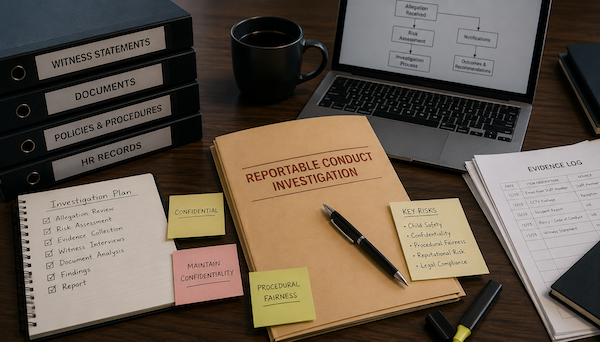
Responding to a Reportable Conduct allegation is one of the most challenging situations an organisation can face.
Whether the allegation arises in a school, childcare service, sporting club, disability provider or community organisation, the decisions made during the first few days can have lasting consequences.
While every matter is different, there are several common mistakes that can undermine an investigation, expose an organisation to unnecessary risk and reduce confidence in the outcome.
Understanding these pitfalls can help organisations respond professionally, protect children and ensure the investigation is conducted fairly.
1. Treating the Allegation as a HR Matter Only
Reportable Conduct investigations involve far more than employee performance or workplace conflict.
They often engage child protection obligations, governance responsibilities and legislative requirements that extend beyond ordinary Human Resources processes.
Organisations should carefully consider whether the matter requires specialist investigative expertise rather than a routine internal HR response.
2. Failing to Act Promptly
Delays can significantly affect an investigation.
Important evidence may be lost, CCTV footage overwritten, witness memories fade and electronic communications deleted.
Acting promptly does not mean rushing to conclusions—it means taking appropriate steps to preserve evidence and protect those involved while a thorough investigation is conducted.
3. Conducting Informal Interviews
One of the most common errors is asking managers to “have a quick chat” with witnesses before an investigation begins.
These conversations may unintentionally influence witness evidence, create inconsistencies or compromise the integrity of later interviews.
Witness interviews should be properly planned and conducted using recognised investigative techniques.
4. Failing to Preserve Evidence
Relevant evidence extends well beyond written complaints.
Organisations should consider preserving:
- CCTV footage;
- emails;
- text messages;
- messaging applications;
- personnel records;
- access logs;
- photographs;
- incident reports; and
- any other material relevant to the allegation.
Early preservation of evidence is often critical to establishing the facts.
5. Ignoring Procedural Fairness
Protecting children remains the highest priority.
However, organisations must also ensure that the person who is the subject of the allegation receives procedural fairness.
This includes providing an opportunity to understand the allegations, respond to them and have that response genuinely considered before findings are made.
Fair investigations produce stronger and more defensible outcomes.
6. Allowing Bias to Influence the Investigation
Investigators should approach every matter with an open mind.
Beginning an investigation having already decided who is right or wrong undermines the entire process.
Findings should always be based on evidence—not assumptions, opinions or workplace politics.
7. Poor Confidentiality
Information about Reportable Conduct allegations should only be shared with those who genuinely need to know.
Poor confidentiality can:
- compromise witness evidence;
- affect procedural fairness;
- damage reputations;
- discourage reporting; and
- undermine confidence in the investigation.
Maintaining confidentiality protects everyone involved.
8. Using Investigators with Conflicts of Interest
An investigator who supervises one of the parties, has an existing relationship with those involved or may later become a witness can create concerns about impartiality.
Even where no actual bias exists, the perception of bias may undermine confidence in the findings.
Independent investigators help eliminate these concerns.
9. Poor Investigation Records
Professional investigations require comprehensive documentation.
This includes:
- investigation planning;
- evidence registers;
- interview records;
- document management;
- decision-making processes; and
- clear reasons supporting findings.
Well-maintained records assist organisations in demonstrating that the investigation was conducted properly and fairly.
10. Failing to Learn from the Investigation
Every Reportable Conduct investigation provides an opportunity to strengthen organisational systems.
Following completion of an investigation, organisations should consider whether improvements are required to:
- policies;
- procedures;
- supervision;
- recruitment;
- staff training;
- reporting mechanisms; or
- organisational culture.
Learning from investigations helps reduce future risk and supports a safer environment for children.
Professional Investigations Protect Organisations
Most organisations genuinely want to respond appropriately when allegations arise.
However, investigations involving children are complex and require careful planning, specialist investigative skills and a commitment to procedural fairness.
Engaging an independent investigator can provide confidence that the investigation has been conducted professionally, objectively and in accordance with recognised investigative principles.
How Regional Queensland Investigations Can Assist
Regional Queensland Investigations conducts independent Reportable Conduct investigations throughout Queensland for schools, childcare providers, sporting organisations, disability service providers, government agencies and community organisations.
Our investigators provide:
- independent investigations;
- impartial witness interviews;
- evidence-based findings;
- comprehensive investigation reports;
- procedural fairness throughout every investigation; and
- practical recommendations that support effective governance and child safety.
Our objective is simple—to establish the facts through fair, professional and defensible investigations.
Contact Regional Queensland Investigations
If your organisation requires an independent Reportable Conduct investigation anywhere in Queensland, Regional Queensland Investigations can assist.
Regional Queensland Investigations
📞 1300 870 923

Jason King is the Director of Regional Queensland Investigations Pty Ltd. He has a background in law enforcement, compliance, workplace investigations and corporate investigations, assisting businesses and organisations across regional Queensland and the Northern Territory.