
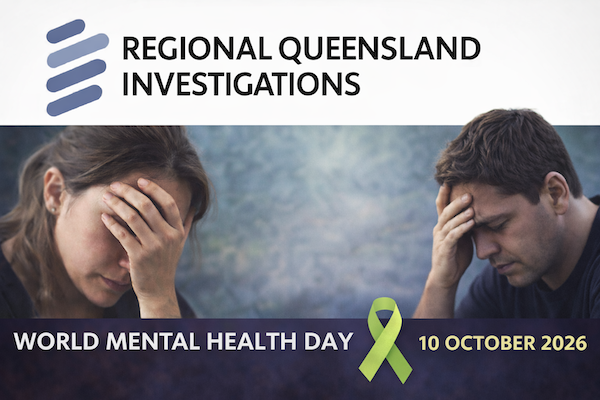
World Mental Health Day – Mental Health, Investigations and Duty of Care in Queensland
Today is World Mental Health Day is an opportunity to recognise that mental health is not a standalone issue. It is deeply connected to safety, decision-making, institutional response, and duty of care.
In investigative work across Queensland, mental health is frequently a key underlying factor — not only in individual harm, but in how systems respond, escalate, or fail to act.
Mental Health in the Investigative Context
Mental health issues often intersect with investigations in complex ways. We regularly encounter matters involving:
prolonged psychological distress
exposure to violence, abuse, or coercive control
unresolved legal or regulatory pressure
loss of autonomy through guardianship or institutional decisions
workplace conflict, misconduct processes, or suspension
repeated engagement with systems that do not resolve underlying issues
In many cases, mental health concerns are present long before a crisis, but are not adequately recognised or addressed.
Mental Health as a Risk Indicator, Not a Character Flaw
One of the most common failures we see is the misinterpretation of mental health distress.
Individuals experiencing anxiety, depression, trauma, or psychological injury may be labelled as:
difficult
non-compliant
unreliable
emotionally reactive
When this occurs, risk is minimised rather than assessed, and decision-making becomes procedural instead of protective.
Mental health vulnerability should trigger greater care and oversight, not disengagement.
Cumulative Pressure and Psychological Harm
Mental health deterioration is often linked to cumulative stress, not a single event.
This can include:
prolonged investigations without resolution
unclear or inconsistent decision-making
lack of communication or transparency
power imbalance between individuals and institutions
fear of consequences for speaking up
When pressure is ongoing and unresolved, psychological harm can compound — increasing risk to the individual and others.
Where Systems Often Fail
1. Fragmented Responsibility
Mental health concerns are frequently treated as “someone else’s issue”.
We see matters where:
warning signs are noted but not escalated
mental health is acknowledged but not acted upon
no single agency takes ownership of risk
This fragmentation creates gaps where people fall through.
2. Process Over People
Strict procedural compliance can overshadow genuine wellbeing concerns.
In some cases:
box-ticking replaces meaningful assessment
timelines matter more than impact
escalation thresholds are too high
This approach can exacerbate harm rather than reduce it.
3. Lack of Independent Review
When decisions affecting vulnerable individuals are made internally, without external scrutiny, errors can persist unchecked.
Independent investigation is often the only mechanism capable of:
reviewing cumulative decision-making
identifying systemic pressure points
assessing whether duty-of-care obligations were met
The Role of Investigations in Mental Health Related Matters
Investigations do not replace mental health care — but they play a crucial role by:
documenting patterns of harm or pressure
establishing timelines of contact and response
examining whether risks were identified and escalated
assessing institutional decision-making
supporting accountability and system improvement
In many cases, investigations are initiated after harm has occurred. Their value lies in preventing repetition.
A Regional Queensland Reality
Mental health challenges are often amplified in regional and remote Queensland due to:
limited access to specialist services
long wait times
lack of anonymity
stigma around seeking help
fewer escalation pathways
These factors make early recognition and coordinated response critical.
Mental Health Support in Queensland
If you or someone you know is experiencing mental health distress, support is available.
Immediate Risk
Call 000
24/7 Support
Lifeline – 13 11 14
Beyond Blue – 1300 22 4636
Suicide Call Back Service – 1300 659 467
Aboriginal and Torres Strait Islander Support
13YARN – 13 92 76
Youth Support
Kids Helpline – 1800 55 1800
Seeking support does not require a diagnosis, referral, or formal complaint.
Why World Mental Health Day Matters
World Mental Health Day is a reminder that mental health is not just a personal issue — it is a systems issue.
Protecting mental health requires:
listening early
recognising cumulative harm
coordinating responses
escalating risk appropriately
reviewing failures honestly
Strong systems reduce harm. Weak systems amplify it.
Our Position
At Regional Queensland Investigations, our role is not clinical treatment. It is to:
establish facts
examine decision-making
identify systemic pressure and failure
support accountability
contribute to safer outcomes
World Mental Health Day reinforces the importance of care, vigilance, and responsibility — particularly when individuals are navigating complex systems under stress.

Jason King is the Director of Regional Queensland Investigations Pty Ltd. He has a background in law enforcement, compliance, workplace investigations and corporate investigations, assisting businesses and organisations across regional Queensland and the Northern Territory.