
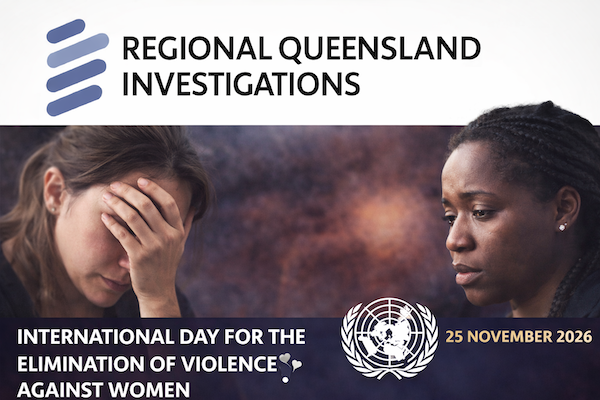
International Day for the Elimination of Violence Against Women – Investigations, Harm, and Accountability in Queensland
Today is the International Day for the Elimination of Violence Against Women recognises a global reality that is also deeply present in Queensland: violence against women remains widespread, under-reported, and often poorly responded to.
For those working in investigations, this is not an abstract or symbolic issue. It is reflected in real harm, repeated system failures, and long-term consequences for victims when warning signs are missed or ignored.
Violence Against Women: What We Actually See
Violence against women rarely presents as a single incident. In many cases, it emerges as a pattern of behaviour over time.
In our investigative work across Queensland, we have been involved in matters that include:
Sexual assault and rape allegations
Domestic and family violence
Coercive control and psychological abuse
Financial control and exploitation
Stalking, intimidation, and threats
Failures by institutions to act on repeated disclosures
These matters often escalate because early intervention did not occur, or because disclosures were minimised, mischaracterised, or not properly investigated.
The Nature of Harm
The harm caused by violence against women extends far beyond physical injury.
We regularly see:
Long-term psychological trauma
Loss of housing or financial stability
Breakdown of family and social supports
Increased vulnerability to further exploitation
Fear of engaging with police or authorities
In some cases, women remain in dangerous situations not because they lack awareness, but because they lack safe and effective pathways out.
Why Many Cases Are Missed or Mishandled
1. Coercive Control Is Often Misunderstood
Coercive control does not always involve physical violence. It includes:
Isolation from friends and family
Monitoring of movements and communications
Financial restriction
Threats tied to children, housing, or reputation
These behaviours are often minimised until a serious incident occurs — despite being strong indicators of escalating risk.
2. Disclosures Are Fragmented
Many women disclose harm incrementally, not all at once.
We see cases where:
Multiple reports are made over months or years
Each disclosure is treated in isolation
No holistic risk assessment occurs
Without a joined-up investigative approach, patterns are missed.
3. Fear of Consequences
Women may hesitate to pursue formal complaints due to fear of:
Retaliation
Not being believed
Losing children or housing
Escalating violence
When systems respond poorly, this fear is reinforced.
The Role of Investigations
Independent investigations play a critical role in violence-against-women matters by:
Establishing patterns, not just isolated incidents
Documenting evidence suitable for courts, regulators, and oversight bodies
Assessing institutional response, not just individual behaviour
Identifying missed opportunities for intervention
Investigations are often the only mechanism capable of examining what went wrong after harm has occurred — and how future harm might be prevented.
Accountability When Systems Fail
We have been involved in matters where:
Multiple reports were made with no meaningful action
Risk indicators were documented but not acted upon
Responsibility was shifted between agencies
Victims were left unprotected despite clear warning signs
Accountability is not about blame for its own sake. It is about:
Learning from failures
Improving responses
Preventing repeat harm
Resources Available in Queensland
Queensland has a range of specialist services available to women experiencing violence. Accessing the right support early can be critical.
Emergency
Police – 000 (immediate danger)
Domestic and Family Violence Support
DVConnect Womenline – 1800 811 811 (24/7)
DVConnect Webchat – www.dvconnect.org
Mensline (for perpetrators seeking support) – 1300 600 636
Sexual Assault Support
1800RESPECT – 1800 737 732 (24/7 counselling and support)
Queensland Sexual Assault Helpline
Legal and Advocacy Support
Legal Aid Queensland
Women’s Legal Service Queensland
Community Legal Centres Queensland
Accessing these services does not require a formal police complaint and can occur confidentially.
A Regional Reality
In regional and remote Queensland, additional barriers exist:
Limited local services
Long distances to specialist support
Overlapping personal and professional relationships
Fear of being identified within the community
These factors make independent, external oversight particularly important.
Why This Day Matters
The International Day for the Elimination of Violence Against Women is a reminder that:
Violence is often predictable
Harm is often preventable
Early intervention saves lives
Accountability improves systems
Justice requires more than laws — it requires effective investigation, proper response, and genuine commitment to protection.
Our Position
At Regional Queensland Investigations, our role is not to advocate outcomes, but to:
Establish facts
Preserve evidence
Examine decision-making
Support accountability where systems fail
Violence against women is not inevitable. It is the result of choices — including institutional choices — and it demands serious, evidence-based attention.

Jason King is the Director of Regional Queensland Investigations Pty Ltd. He has a background in law enforcement, compliance, workplace investigations and corporate investigations, assisting businesses and organisations across regional Queensland and the Northern Territory.